|
Battlestar Galactica
Redemption
Novel
By Richard Hatch and Brad Linaweaver
(The page numbers come from the 1st printing, hardcover edition,
published October 2005) |
The Kobolian ark, which has saved the lives
of Apollo's 800 left-behind contingent of humanity, now brings
death.
Notes from the BSG chronology
References in the book place it immediately after the events of
Destiny.
Didja Know?
This, the seventh book in Richard Hatch's continuation novels of
the original BSG, ends on a cliffhanger and was intended to be
continued in an eighth book in the series which has reportedly
been written but never published. Some arguments over publishing
rights arose, resulting in the loss of licensing for BSG
by Ibooks. It is uncertain whether the eighth book will ever be
published.
This final book (so far) of the Hatch series continues the
infuriatingly annoying habit of retroactively changing plot
details of past books. For example, each book seems to jump the timeline of
the story farther into the future even though the story picks up
immediately after the previous novel! In
Paradis, Cassiopeia's
son is just born. Then in
Destiny,
he seems to have the attributes of being at least a toddler
(usually a child 1-2.5 years of age). Now, as this book opens
immediately after the events of
Destiny,
the boy is described as 5 years old!
Didja Notice?
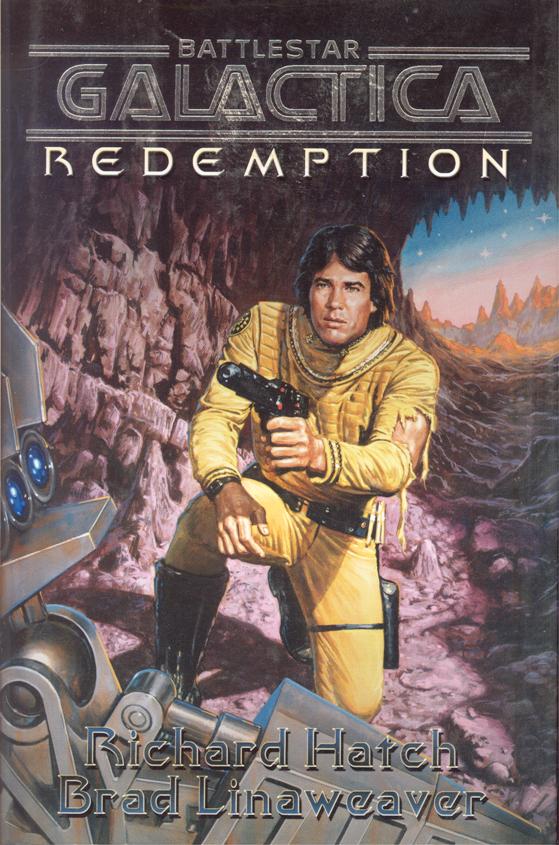
The cover of the novel seems to have nothing
to do with the storyline of the book. Maybe the cover painting
is actually based on the events of the already-written but
never-published follow-up novel? It shows Apollo wearing a torn
uniform in a cave, brandishing his weapon at some kind of
mechanical construct; no such scene occurs in this novel.
Page 1 indicates that Cassiopeia's son is 5
years old, so this story opens about 5 years after the events of
Paradis, when he was born (of
course, see the note in the Didja Know section above pointing
out that the timeline of these novels keeps changing
retroactively).
I'm not even going to bother pointing out that it should be
"yahrens", not "years".
On page 4, Apollo seems to refer to Earth as
the original world. But Earth is only another colony of humans,
which originally arose on the planet
Parnassus according to the events of
Armageddon. This fallacy is
also repeated among Imperious Leader's thoughts on page 38.
On page 6, Athena thinks to herself that she
is more like Commander Cain than she is her own father, Adama.
Now that the fleet is split up, with Apollo
no longer among the main fleet, page 7 implies that President
Tigh is now also Commander Tigh, commanding the Galactica,
while Athena remains in command of the Daedalus, though
Tigh also refers to her as the supreme commander. (Later the book conflicts with itself as to whether
Athena is now in command of the Galactica or the
Daedalus.)
On page 7, Tigh uses the phrase "Land of
Nod" while telling Athena she needs to get some sleep. It seems
out of place for a Colonial to use the phrase, as its origin on
Earth as a reference to the world of sleep is a play on the
Biblical Land of Nod, east of Eden, to which the Biblical Cain flees after
murdering his brother, Abel.
This book continues the tradition of
confusing the roles of Drs. Salik and Wilker.
Dr. Salik (Wilker) makes references to the
fleet's radscanners, able to detect all kinds of energy and
radiation.
The Cylon centurion who survived the
explosion of the Imperious Leader's baseship and is left
floating in space is said to be one of the new centurions with a
reptilian brain. But earlier novels have stated that most of the
centurions were reptilian, and it was just that some entirely robotic ones
were created as well when troops
were running low in the war against humanity.
Page 12 seems to suggest that there was
peace with the Cylons when Starbuck was training as a Viper
pilot, before the betrayal at the Battle of Cimtar still in the
future. The author seems to be confusing the phony peace treaty
in "Annihilation" as some long
term treaty that was already in place. Also, during
Sheba's flashback to her youthful training days, she
reminisces
on the Council's promise of generations of peace in the
Colonies.
Page 13 reveals that Starbuck's first sexual
experience was with a socialator aboard a space hotel.
Page 26 reveals that Sheba began her Warrior
training when she was 15 yahrens old.
On page 29, the CO of young Sheba's training
class uses the term "slagger". According to the Hatch glossary,
a slagger is a slothful person.
Aboard the derelict Cylon basestar on page
31, Boomer shows his skill with electronics, as he did in
episodes of the TV series such as
"Fire in Space" and "The Hand
of God".
Page 35, suggests a reason that Imperious
Leader was willing to keep Baltar alive for so long. Imperious
Leader had determined that Baltar had a way of sizing up
problems and a propensity for sharing his thoughts with anyone
who would listen. The Cylon leader considered it a crime to
eliminate such a valuable resource.
Page 37 gives a reason why Baltar was
willing to side with the Cylons for a phony peace treaty and
betrayal of humanity. He had determined that Cylon victory was
inevitable and it was better that certain members of the human
species were allowed to survive after the defeat than to have
all humanity wiped out of the universe.
Page 38 suggests that Imperious Leader
considers Apollo to be the most unpredictable of all humans in
Cylon experience.
Also on page 38, Imperious Leader reflects
on the new Cylons intention to combine human DNA with that of Cylons in
their biotech experiments. But according to previous novels in
the series, that was already done long ago by Count Iblis when
he was modifying the original Cylon species to be the perfect
warriors.
Seeing her constantly washing her hands, on
page 38 nurse Elayna remarks that her assistant, Vesil, is germaphobic. The actual term for someone with an
obsessive-compulsive fear of germs is mysophobic.
Page 43 reveals that the blood of reptilian
Cylons is purple.
On page 46, Apollo remarks on the time when
his father disagreed with Commander Cain on using both their
battlestars to go up against three Cylon basestars. This is a
reference to "The Living
Legend" Part 2.
On page 51, Apollo remarks that he never
looks a gift daggit in the mouth. This is a twist on our own
English expression of "don't look a gift horse in the mouth."
In Rebellion,
Starbuck uses the pharase, "don't look a
gift Boray in the mouth".
On page 51, the Colonials discover a cache
of Cylon weapons aboard the derelict basestar: zap lasers that
discharge electricity, disrupters that tune electromagnetic
force into a wave that vibrates a living target to death, and
hand guns that emit sonic waves.
On page 61, Caran refers to the basestar as
a Cylon space oyster. The basestars do look vaguely like the
opened shell of bivalve molluscs.
Page 72 implies the fleet will spend a month
or more travelling through hyperspace to get to the next
habitable system, about 3 light-years from the Paradis system,
possibly running out of food stores before arrival. This is the
first indication we get of the amount of time it takes to travel
with Colonial hyperlight drives. Fine, as far as it goes. But
what happened to the QSE drives supposedly installed for all
ships in the fleet in
Resurrection? Even if
the tear-down and rebuild of some ships in
Paradis resulted in the loss of
QSE for some ships, what's to prevent the Galactica or
others from attaining the new planetary system and bringing back
food for the rest?
On page 81, Aardema remarks that it would be
a cruel irony if the Cylons could lose the battle, but kill
humanity with a disease. In the deleted scenes of
"Exodus", it is revealed that Serina
and many other refugees were infected by a bio-agent in the
bombs dropped on the Colonies by the Cylons in
"Annihilation".
Aboard the Kobolian ark, the Colonials find
the hibernating forms of several humans of the Thirteenth Tribe,
which they decide to awaken. This is very similar to the events
of the War of Eden mini-series from Maximum Press.
Page 87 reveals that the Cylons created
cloned duplicates of Baltar's brain. Page 167 reveals that the
human brain which is part of the Cylon organic computer aboard
the derelict baseship is also a duplicate of Baltar's.
Being dead, Baltar realizes he might now be
able to view the past and future besides just the present.
Page 94 reveals that there are now civilians
living on the battlestars beside the military, to limit the
numbers that had to be left behind in
Destiny.
Page 95 reveals that Dr. Salik (Wilker) has
been reassigned to the
Daedalus, to work as Athena's resident genius.
Discussing the fleet's food shortage, Tigh
remarks to Athena that he wishes there'd be a cosmic mealprep
floating in space between the fleet and its destination.
According to the Hatch glossary, a mealprep is a kitchen.
Page 98 reveals that several civilian ships
of the fleet have been converted to medical ships to house and
care for the sickest individuals since leaving Paradis. One of
these ships is called the Gardener.
On page 105, Elayna's correction of Apollo
is stated twice in
a row; an obvious miss in the editing of the book.
Page 105 reveals that the ark has one person
in a cryonic freeze pod and several others in more sophisticated
hibe (hibernation) pods.
Page 109 reveals that Cassie has tried to
give her son a name several times, but he always refuses to
answer to anything she has chosen. On page 163, Starbuck
suggests calling him Apollo, Jr!
Page 112 contains the following sentence:
"What we have here," Bojay slowly drawled, "is a success at
communication." This is a reference to the opposite quote, also
spoken in a drawl, by actor Strother Martin in the 1967 classic
film Cool Hand Luke: "What we've got here is failure to
communicate."
Page 116 reveals that Commander Athena
ordered the destruction of the Gardener and the deaths
of everyone on board in order to reduce the number of people
that needed to be fed in the fleet, what with the shortage of food.
On page 120, the ill Sheba remarks that she
hasn't had a cold in a long time and Apollo tells her to get
plenty of coneth stew. This is probably the Colonial version of
our own reference to the
common folk remedy
of eating chicken soup to fight off cold and flu.
On page 123, Baltar thinks of himself as
both a traitor and a hero, trailing Promethean fire in his wake.
This is a reference to the Greek mythological figure of
Prometheus, one of the Titans, who betrayed his fellow gods and
gave fire to humanity, making him a traitor to the Titans and a
cultural hero to humanity.
Pages 123-124 present Bojay as becoming
almost a super-heroic character. By day he repairs Vipers and
mentors some of the young Warrior cadets. During sleep shifts,
he roams the corridors of the Galactica seeking the
most incorrigible of youths to be rejuvenated as contributing
members of fleet society, using superior fighting skills to take
down young punks who oppose him with violence, often earning
their respect in the process. Later, Bojay is seriously injured
rescuing two cadets from a fire in the landing bay.
On pages 128-129, Apollo muses on Baltar's
accomplishment of communicating with him from beyond the grave
as equal to the Gamon reaching him after the destruction of
their home planet Paradis. But I don't recall any instance of
the Gamon having done so after their apparent deaths in the
destruction of the planet in this or the previous novel!
On page 134, the phrase "I was one of a
select view" is used instead of what was meant, "I
was one of a select few."
Page 138 reveals that Troy is cheating on
Dalton with Rhaya.
In paragraph 8 of page 143, Cassie is
referred to as Connie!
On page 149, Boomer speaks of an old summer
house he had, which suffered from some infestations of crawlons
and flanchettes. "Crawlon" is the Colonial term for "spider" and
a flanchette, according to the Hatch glossary, is a stinging
insect. Probably the term "flanchette" was derived from the
English word "flechette", which is a steel, dart-like projectile.
Page 150 refers to the death of Apollo's
brother, Zac, as the first death of the Cylon War. Uh, no.
Again, the author is erroneously thinking that humans and Cylons
were at peace before the Battle of Cimtar in
"Annihilation".
Page 167 suggests that a number of cloned
Baltar brains are in use around the Cylon Empire.
Page 173 suggests that Trays had admired
Dalton from afar. I wouldn't really call it "from afar"
considering the two were dating when Dalton was feeling critical
of Troy's love in Resurrection.
On page 178, one of the Noman-like survivors
on the Kobolian ark seems to suggest that his kind are
Borellian Nomen. But
Armageddon describes
the Nomen, led by Borellus, as having arrived on Caprica
millennia ahead of the exodus from Kobol and evolving into their
current state on Caprica. So their should have been no Nomen to
board to ark on Kobol in the first place.
On page 180, Baltar uses the phrase "as
crazy as a Cylon hairdresser." I wonder if this is a reference
to the afro-like conglomeration of hair or wiring on top of
Imperious Leader's head!
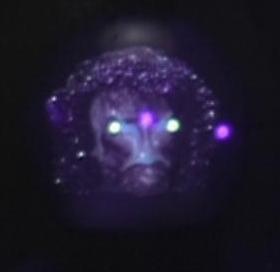
Page 181 reveals that the plague which
struck the Kobolians thousands of years ago, as seen in this
novel, was created by Count Iblis. He also created a cure, which
is found aboard the Cylon basestar thanks to information from Baltar.
On page 182, Baltar remarks, about Count
Iblis' desires, "To truly be God, you need to create ex
nihilo," to which Apollo responds, "Out of nothing."
Ex nihilo is Latin for "out of nothing".
Unanswered Questions
Where do the split groups of Colonials go
from here? What will be the outcome of the Cylon civil war? Will
Cassie's son turn evil? As mentioned above, the eighth novel has
never been published, so we may never find out.
Back to Episode Studies