 |
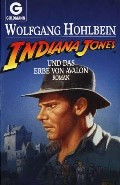
Indiana Jones
The Legacy of Avalon
Novel
Written by Wolfgang
Hohlbein
Cover by Oliviero Berni
1994
(Page numbers come from the mass
market German paperback edition
of
Indiana Jones
und das Erbe von Avalon,
3rd
printing, 1994)
|
A series of strange occurrences in England
and Belgium lead Indy to the Belgium Resistance and a Nazi plot
to acquire the Sword of Kings...King Arthur's legendary sword
Excalibur.
Notes from the Indiana Jones chronology
This novel takes place in
September 1940.
Didja Know?
This is a study of the German novel Indiana Jones
und das
Erbe von Avalon (Indiana
Jones and the
Legacy of Avalon). This study is based on
the English translation by Rachel Schneider, hosted at
Indymag.com. Thanks, Rachel!
This novel is noted in the Indiana Jones timeline in
The World of Indiana Jones as taking place in 1935,
right after the events of
Temple of Doom, and describes events quite differently
from what actually takes place in the novel. For the PopApostle
chronology, we are accepting the novel's original setting in
September 1940.
The story of this novel involves the retrieval of the mythical
sword Excalibur. This same theme is also seen in the comic book
story "The Sword of Excalibur" from
Indiana Jones Adventure Magazine. See that
story's upcoming PopApostle study for a semi-reconciliation of
the two stories.
Notes from
The Lost Journal of Indiana Jones
The Lost Journal of Indiana Jones is a 2008 publication
that
purports to be Indy's journal as seen throughout The
Young Indiana Chronicles
TV series
and the big screen Indiana
Jones movies. The publication is also annotated with notes
from a functionary of the
Federal Security
Service (FSB) of the Russian Federation, the successor
agency of the Soviet Union's KGB security agency. The KGB relieved Indy of his
journal in 1957 during the events of Indiana
Jones and the Kingdom of the Crystal Skull.
The notations imply the journal was released to other
governments by the FSB in the early 21st Century. However, some
bookend segments of The
Young Indiana Chronicles
depict Old Indy still in
possession of the journal in 1992. The discrepancy has never
been resolved.
The journal as published does not mention the events of this
novel, going from
entries about the events of
The Fate of Atlantis in
May 1939 to Indy's time working with Colonel George "Mac" McHale
during 1944. A five year gap seemingly left un-journaled.
Story Summary
The novel opens aboard a German U-boat off
the coast of England during WWII. The crew waits in tense
silence for a spy contact, but something unnatural begins to
happen: a dense, unnatural fog rolls in far too quickly. Within
it, the captain glimpses something impossible—what looks like
land where none should exist. Moments later, a small rowboat
appears out of the fog carrying two figures. When the U-boat
surfaces to investigate, one of the figures boards the submarine
and attacks with a sword slaughtering several crew members
before being shot. The survivors are shocked to discover that
their attacker appears to be a medieval knight.
In New York, Indiana Jones interacts with
Professor Higgins and Marcus Brody at Barnett College. Higgins,
a medieval expert, receives a telegram about a mysterious man in
England who speaks an ancient dialect no one can understand.
Before Indy can fully process the situation, Higgins is attacked
in his room by unknown assailants. Indy intervenes and fights
them off. Indy decides to accompany Higgins to England, sensing
that this mystery is far more significant—and dangerous—than it
appears.
In occupied Belgium, Linda Leclerque, a
resistance fighter, alongside her companion Frederic, is tasked
with investigating suspicious Nazi activity near a quarry. What
they discover is the Germans have constructed what appears to be
a medieval castle inside the quarry. However, upon closer
inspection, much of it is revealed to be a façade—a staged
environment rather than a true fortress. Before they can escape,
they are discovered by guards dressed in medieval armor but
armed with modern weapons. Frederic is killed during their
escape, and Linda barely survives, later reporting the strange
discovery to the resistance.
Indy and Higgins arrive in Liverpool and
visit the mysterious young man mentioned in the telegram— Joshua
Brushguy—who is being held in a hospital. He is terrified of
modern objects and speaks an ancient Welsh dialect. Higgins is
able to communicate with him and learns that Brushguy claims to
be the squire of Sir Lancelot. Through careful questioning,
Higgins becomes convinced that Brushguy is telling the truth;
the young man’s knowledge of medieval customs, language, and
history is too detailed to be fabricated. More disturbingly, he
reacts violently when Higgins mentions a secret name of
Lancelot—one that no modern scholar should know. This convinces
Higgins that Lancelot himself must be real and recently present
in the modern world.
Meanwhile in Scotland, a subplot follows a
thief named Perkins attending a terrible theatrical performance.
During the show, German commandos secretly infiltrate the area.
They capture the entire acting troupe and force them into
trucks, revealing a strange objective: the Germans want these
actors alive. The implication becomes clear—the actors are
needed for a staged performance or deception. This ties back to
the fake medieval castle seen earlier. The Germans are
assembling elements to recreate a believable historical
environment, suggesting a plan to manipulate someone who
believes they are still in the Middle Ages.
Back in Belgium, German officer Kielmann
receives direct orders from Hitler regarding a mysterious
prisoner. The conversation reveals that the Nazis consider this
prisoner extremely valuable. Kielmann is confused by the bizarre
instructions, which involve maintaining the medieval illusion.
He meets a French collaborator—a man named Belloq—who explains
that the prisoner must willingly reveal information. Traditional
interrogation methods won’t work. Instead, they must gain his
trust. Belloq hints that the prisoner is connected to Arthurian
legend and that the goal is to obtain a legendary
sword—Excalibur—which is believed to hold immense symbolic or
supernatural power.
In England, Indy is forcibly ordered by
British intelligence to leave the country, supposedly for his
safety. Suspicious of their motives, he resists and
escapes—jumping from a moving airplane during takeoff. Though
injured, he uses the situation to return to the hospital. Indy
discovers that Higgins and Brushguy have been taken by secret
agents. Realizing the situation is escalating quickly, he steals
an ambulance and pursues them.
In Scotland, German commandos prepare to
transport the kidnapped actors out of Britain.
Indy reunites with Higgins and Brushguy
during a flight. Higgins explains what he has learned: Brushguy
and Lancelot came from Avalon, the mythical resting place of
King Arthur and his knights. They were sent to retrieve
Excalibur to help Britain in its time of need. However, their
journey went wrong—they encountered the German U-boat, and
Lancelot was captured. The Germans now possess Lancelot and are
attempting to use him to locate Excalibur. Indy realizes the
stakes: if the Nazis obtain the sword, they could exploit its
symbolic or supernatural power.
Back in Belgium, Belloq elaborates on the
Nazi plan. He confirms that the captured knight is indeed
Lancelot and that Excalibur is real. The Germans intend to use
Lancelot to find the sword, believing it will grant them power
over Britain. Belloq reveals his personal motivation as well—he
is driven by ambition and a desire to acquire powerful
artifacts. Unlike the German officers, he fully embraces the
mystical aspect of the mission.
Indy, Higgins, and Brushguy, try to escape
both German forces aboard a transport plane when British flak
damages the plane, killing the pilot. Indy struggles to keep the
aircraft under control despite having limited flying experience.
German bombers eventually escort the
crippled plane, unknowingly guiding Indy toward Belgium—the very
place the Nazis want him. Realizing this, Indy understands they
are being drawn directly into the enemy’s trap. With fuel
running out and no safe landing options, he is forced to
crash-land near the Nazi stronghold.
The German forces regroup at an airfield
near Ghent, transporting kidnapped actors and preparing for the
next phase of their plan. Their operation appears disorganized
beneath the surface, with many soldiers confused about the true
objective and beginning to question why they are involved in a
medieval charade. Still, orders are followed, and the stage is
set for the manipulation of Lancelot.
Indy crash-lands the plane near the quarry.
Though the landing is rough and the plane is destroyed, Indy,
Higgins, and Brushguy survive. German fighters quickly arrive
and bomb the wreckage, assuming no survivors. The group escapes
into nearby terrain, narrowly avoiding detection. Indy realizes
they are now close to the Nazi base and must act carefully to
survive and rescue Lancelot. The group hides in a foul
underground cesspit to evade German search parties. Eventually,
they escape detection and plan their next move.
With help from Linda and the resistance,
Indy and his allies regroup and move toward the castle. They
decide to infiltrate the castle using disguises as actors or
extras, taking advantage of the Germans’ staged medieval
environment. The plan is risky, but it offers their best chance
to reach Lancelot without direct confrontation.
Inside the castle, Indy and his companions
witness the bizarre spectacle the Germans have created. The
setting is an elaborate but flawed imitation of a medieval
court, complete with costumes, props, and a staged performance.
They observe Lancelot at a banquet, clearly being manipulated by
the Nazis. Belloq is present, orchestrating the deception. The
group prepares to act, realizing that timing and surprise will
be critical to their success. Chaos erupts during the staged
performance when a fire breaks out, providing Indy with the
opportunity to strike. He fights through guards and disrupts the
event, while Belloq confronts him directly. During the
confrontation, Indy realizes this Belloq is not the same man he
believed dead, but his twin brother.
Indy and his allies escape with Lancelot
through underground tunnels beneath the castle. The Germans
pursue them, but the group manages to stay ahead. They reach the
surface near a lake where Lancelot retrieves Excalibur in a
supernatural sequence involving the Lady of the Lake. The
environment becomes surreal, suggesting a connection to Avalon
itself.
Belloq attempts to claim the sword but is
destroyed by its power, demonstrating that Excalibur cannot be
wielded by the unworthy. The Lady of the Lake declares that the
modern world is no place for Arthurian heroes. The brutality and
scale of modern warfare—symbolized by bombs, guns, and total
war—make traditional heroism obsolete. Lancelot and Brushguy
return to Avalon with Excalibur, ensuring it cannot be exploited
by either side. Indy and his companions are left with the
realization that some powers are too dangerous—or too out of
place—for the modern world.
Characters appearing or mentioned in this story
U-87 crew
Kapitänleutnant Hansen (dies in this novel)
U-87 radio officer
Polecat
U-87 first officer Stefan Willumeit (dies in this novel)
Müller
Schorbeck
Professor Lucius Llewellyn Higgins
Indiana Jones
Marcus Brody
Dr. Grisswold (dean of Barnett College, mentioned only)
strange man
Higgins' colleague
four thugs
Linda Leclerque
Belgian freedom fighters
Frederic (dies in this novel)
Adolf Hitler (mentioned only)
German soldiers
Professor Wilbur McMurray
Mr. Arnold (dies in this novel)
Joshua Brushguy
Lancelot du Loc
King Arthur Pendragon
(mentioned only)
Hamlet (an actor who played Hamlet in a local play)
Perkins
theatre goers
German agents
Oberst Kielmann
Melbrink
Kielmann's aide
Belloq (twin brother of Rene Belloq, dies in this novel)
German major
German mechanics
Major Harold Kant
Friederich Siedler
Gerald
Belgian farm family
Linda's theatre friend (mentioned only)
Resistance truck driver
(mentioned only)
Rene Belloq (mentioned only, deceased)
Gefreiter Horbach
Schmidt
Schlosser
Morgana Le Fay
Page 8 remarks that it was an icy autumn this year and the winter
would be a hard one. If it's autumn now, this suggests it is now
after September 23, when the autumnal equinox occurred. And the text
is correct, the winter of 1940-41 is considered one of the coldest
of the 20th Century in parts of Europe.
Also on page 8, Hansen muses on the interests of the madmen
in Berlin.
Berlin is
the capital of Germany.
On page 8,
Kapitänleutnant is the German term for "Lieutenant
Commander". On page 9, Kaleu is a German abbreviation of
Kapitänleutnant.
On page 9, a Tommy is a slang term for a British soldier. It is
derived from the generic name "Tommy Atkins" used as a placeholder
for a private soldier in British Army booklets, originating in the
18th-19th century.
On page 9, the Spitfire was a British fighter aircraft.
Page 10 states it had been just two days since the first bomb had
fallen on the Kingdom of England. This doesn't seem right if it is
near the end of September as suggested earlier. Depending on how one
views the "bombing of
the Kingdom of England", the first bombs struck in July or August.
The U-87 is to pick up the double agent known as Polecat from the
English coast and transport him to Calais.
Calais
is a French port city at the closest point to England across the
English Channel.
Chapter 2
This chapter opens at Barnett College, the fictitious New York
institution Indy is teaching at at this point in his life.
On page 19, Indy very briefly muses on obtaining his bullwhip, having to do
with a travelling circus, a bad-tempered lion, and the Cross of
Coronado. The full story was seen in
"The
Cross of Coronado".
Professor Higgins is from Caernarvon College in Wales. This
appears to be a fictitious college, though
Caernarvon is an actual small town in Wales.
This novel is the first mention of Dr.
Grisswold, dean of Barnett College. He goes on to be mentioned
or seen in a number of the Hohlbein novels. Grisswold keeps a framed
photo of Indy in his office so that he "never completely forgot the
face of the most absent professor."
Professor Higgins is said to be a professor of medieval studies
and number one in the world in Old English.
Old English is the earliest historical form of the English language.
Page 21 mentions an incident when Indy used his famous classroom
death glare, with which he had once sent a Bengal tiger running (but
that was another story that will be told in due time).
On page 22, Indy tells his students he wants to see the sites of
Charta in chronological order from chapters three through seven in
their textbooks. Charta is a municipality in Columbia.
Higgins receives a telegram about a strange man speaking an
obscure dialect found near
Liverpool.
Page 24 reveals that Brody's office at Barnett is on the ground
floor of the building that also houses Indy's classroom.
On page 25, Indy hits a man attempting to kidnap Higgins on the
chin with his fist and it's a KO. "KO" stands for "knock out".
On page 25, Indy bumps into a man carrying a thirty-eight caliber
Smith & Wesson.
Chapter 3
This chapter opens along a stretch of coastline of occupied
Belgium, four miles west of
Ghent
municipality.
On page 34, the ruthless dictator Linda thinks of as sending
troops into a war they wanted no part of is German chancellor Adolf
Hitler.
On page 38, the Wehrmacht is the name for the unified
German armed forces from 1935-1945 during the Nazi reign.
Chapter 4
This chapter opens with
Joshua Brushguy
in St. Mary’s Hospital, Liverpool. This
appears to be a fictitious hospital for Liverpool,
though there is a St. Mary’s Hospital in Manchester (about 30 miles
away), but it provides services for women and children.
On page 48, Indy remarks to Professor Higgins, who is reluctant
to tell the secret of psychiatric patient Brushguy, "You
know, I’ve experienced a lot that others wouldn’t believe if someone
made a movie about it."
Higgins says that Brushguy told him he was originally from a
village called Monmarth at the southern edge of Wales, which he left
as a child. Since Brushguy is speaking in early Welsh, "Monmarth"
may refer to the modern day city of
Monmouth
in southeast Wales.
Higgins comes to believe that
Brushguy was the squire to the knight Sir Lancelot du Lac due to the
man's knowledge of the ancient past and old Welsh language. Lancelot
was one of the Knights of the Round Table in Arthurian legend, and
often considered the most heroic and handsome.
On page 50, the Isle of Avalon is where the sword Excalibur, of
the King Arthur legend, is often said to have been forged, though
the island is fictitious or its location lost. Excalibur, or the
Sword of Kings, is brought up on page 106.
King Arthur, of course, is the legendary (possibly mythological)
British leader of the late fifth and early sixth centuries. His
knights were the Knights of the Round Table.
On page 50 Mr.
Arnold
gives Higgins a gaze of the type which a person would observe a child who claimed
to have seen Santa Claus on the roof. Santa Claus,
of course, is the folkloric figure who brings gifts to children
around the world on Christmas Eve.
On page 51, Merlin is the infamous
wizard of Arthurian legend. Indy seemingly met Merlin in 1925 in
Dance of the Giants.
Indy remarks to Higgins on page 51 about Mr. Arnold's skepticism
about the Arthurian legend, "Even if you showed him the Holy Grail
now, it wouldn’t change anything. Believe me; I know his type only
too well." Of course, Indy once had the Holy Grail, the cup used by
Jesus at the Last Supper, and is a prime interest of Henry Sr.'s, in
his hands, as seen in The Last
Crusade.
On page 53, Higgins comments, "They say that a witch can take
control of someone if they know their true name. For that reason,
many people had two names. One that everyone knew and was used
officially, and another, secret one that they only told to their
closest, most trusted friends, sometimes not even that," and Indy
reflects that the custom was still in practice even today among some
people. Historically, this has been seen in a number of cultures,
such as Ancient Egypt, Jewish mystical tradition, Australian
aborigines, and some African and Native American cultures.
Chapter 5
This chapter opens in
Aberdeen,
Scotland with a performance of Shakespeare's play Hamlet.
Hamlet is a 1601 tragedy play by William Shakespeare set in
Denmark and is about a Danish royal family.
On page 58, Woodside Airport appears to be a fictitious airfield
of the Woodside area of Aberdeen.
Also on page 58, the term "Krauts" used by Perkins refers to
"Germans".
On page 59, Adolf Hitler is referred to as "the mad Austrian with
the Charlie Chaplin moustache." Hitler was, indeed, Austrian. His
mustache, called a "brush" or "toothbrush" style, is similar to that
worn by Charlie Chaplin (1889-1977), a world-renown British comedic
actor and filmmaker. Chaplin actually did wear the mustache style in
flims as his Little Tramp character prior to Hitler adopting it in
the early 1920s.
Chapter 6
This chapter introduces Oberst Kielmann. Oberst is
German for "Colonel".
On page 66, "Jawohl, mein Führer! Zu Befehl, mein Führer!
Heil Hitler!" is German for "Yes, my Führer! At your command,
my Führer! Heil Hitler!" The title
Führer is German for "Leader".
Page 68 describes that unit leader Melbrink has traded in his BMW
for a donkey in order to blend in with the Middle Ages scenery of
the German castle set piece.
BMW is a German motor
company known for its luxury and performance automobiles, but at
this time was also known for producing vehicles for the German
military.
Chapter 7
On page 72, Indy asks Arnold if the Germans have marched into
London. London
is the capital and largest city of the UK.
After being injured jumping from a taxiing airplane, Indy wakes
up in hospital, asking, "Where am I? This isn’t the Palace Hotel."
There were three
Palace Hotels in London at this time.
Chapter 8
The quotes Perkins makes on pages 97-98 are from Hamlet.
Chapter 9
Page 100 mentions Mordred and Gawain. Mordred is often depicted
as an enemy of King Arthur in the legends, though some accounts
suggest he was an ally and possibly the king's son or nephew.
Gawain is a nephew of King Arthur in the mythology and was involved,
along with his fellow Knights of the Round Table, in the search for
the Grail.
On page 101, Higgins tells Indy, "You
should know that there are more things in heaven and earth…" and
Indy interrupts him to say, "Don’t call me Horatio." This refers to
a quote from Hamlet that Higgins was in the process of
repeating, "There are more things in Heaven and Earth, Horatio, than
are dreamt of in your philosophy."
Horatio is a friend of Prince Hamlet's in the play.
On page 104, Camelot was the name of King Arthur's castle and the
name is often extended to describe his entire kingdom (Britain).
On page 105, Higgins translates Brushguy's narrative of the
arrival and capture of himself and Lancelot in the current time in a
small boat, with a "Leviathan clad in gray steel, whose dart-shaped
head appeared out of the fog." What he's actually describing is a
German U-boat, but "Leviathan" refers to the name of a sea serpent
in Jewish mythology, including the Hebrew Bible.
As Indy explains on page 106 that Hitler would send out his
search dogs to make sure Excalibur falls into his hands, he also
remarks, "I know this game. This has been happening for a few
years." Of course, he is referring to his numerous run-ins with Nazi
agents attempting to retrieve sacred and mystical historical objects
since about 1930 ("The
Viking Scroll").
Indy is
tempted by the search for Excalibur on page 107: "The thought of
finding such a treasure quickened his heart rate. Despite all of the
setbacks in the past years, he hadn’t given up the search." I'm not
positive what is meant by "all of the setbacks in the past years",
but I suppose it means that, despite his general success as an
archeologist, the most famous historical objects he's had in sight
have slipped away from him in one way or another, such as the
Philosopher’s Stone (The
Philosopher’s Stone
and The Cursed Grimoire),
the Ark of the Covenant (Raiders
of the Lost Ark), the Holy Grail (The
Last Crusade),
Noah's Ark (The Great Circle),
the Staff of Moses (The Staff
of Kings), and the ruins of Atlantis (The
Fate of Atlantis). In addition,
The White Witch states that
Indy had previously searched for Excalibur for years
through Glastonbury and
Avalon, ancient battlefields, abbeys and cathedrals, the sacred
assemblages at Stonehenge, and other sacred sites.
When Indy, Higgins, and Brushguy find
themselves abandoned on the airplane in midflight over England, Indy
takes over the cockpit controls, with Higgins asking distrustfully,
"Can you even fly?", to which Indy responds, "Fly yes. Land no." He
gave this same response to his father when they escaped from the
German zeppelin in a plane in
The Last Crusade.
Piloting the plane, Indy sees below them London, and the dome of
St. Paul's
Cathedral and the reflection of light on the Thames. The Thames
is the longest river in England, running through London.
Witnessing the German aerial bombing of London on page 115, Indy
thinks back to WWI, to his time in the trenches of France and the
senseless massacre of soldiers in the blood mills of Verdun. Indy
was a member of the Belgian Army in that war, as seen in a number of
episodes of The Young Indiana Jones Chronicles. Indy was at
the Battle of Verdun in the episode
"Demons of Deception".
The German bombing of London depicted here would be the
beginning of what became known as the Blitz, a bombing campaign
against the UK by Nazi Germany and Fascist Italy from September 7,
1940 to May 16, 1941.
Chapter 10
On page 119, D’accord is French for "all right".
On page 120, Belloq mentions the Lady of the Lake having her
blessed hand over Lancelot. The Lady of the Lake is a mystical,
often fairy-like woman in the Arthurian legend. Some versions of the
legend say she was the guardian of Lancelot and of Excalibur. Later
in this novel she is identified as Morgana Le Fay (Arthur's evil
sister in most versions of the legend, but here is depicted as
aiding the cause of the Round Table). "Le Fay"
is Middle French for "the fairy" (sometimes translated as "the
sorceress").
Also on page 120, et bien is French for "good".
On page 121, Kielmann thinks of bad jokes that some Germans made
that could be deadly if heard by the wrong ears, such as the
Gestapo watching for anyone who dared to insult the hollow earth
theory and that the high command often decided troop movements with
the help of a Ouija board. The Gestapo was the Nazi secret police.
The hollow Earth theory is a pseudoscience concept that the planet
has a large interior void. Some fanciful speculations even proposed
that the void(s) were capable of supporting life and hosted another
civilization from that of the surface. Though he was made to forget
at the end, Indy seemingly visited portions of the hollow Earth in
The Interior World and
The Hollow Earth.
A Ouija board is a board printed with the letters of the alphabet
and numbers for the purpose of communicating with the spirit world
via a planchette which would spell out the words the spirits wish to
speak.
On page 122, "Vichy" refers to the
collaborative role of the nominal government of
Vichy, France
with the German occupiers in WWII. The name of the city came to be a
term used to identify anyone who played a role in the collaboration.
Chapter 11
The code name for the Nazi operation in Ghent is "Mother Goose"
and the airplane bringing Indy, Higgins, and Brushguy is
"Albatross". Mother Goose is the imaginary author of a wide range
children's fairy tales nursery rhymes whose true authors are largely
lost to the mists of time. The name was first used in the 17th
Century. The "Albatross" code name may have been assigned by the
German commander for the idiom "an albatross around your neck,"
meaning an inescapable, burdensome weight, originating from Samuel
Taylor Coleridge’s 1798 poem, "The Rime of the Ancient Mariner". In
the poem, a sailor shoots a friendly albatross, a seabird seen as a
good omen, and is forced to wear the dead bird around his neck as
punishment by his crewmates. When Higgins sees the name as a good
omen himself due to the bird's reputation for graceful flight, Indy
remarks, "Then I’m sure that you’ve never seen how an albatross
lands." While graceful and long-distance fliers, the Albatross tends
to make clumsy landings due to their long, narrow wings and high
approach speed. Their landings can involve skidding on their bellies,
stumbling forward, face-planting into the turf, and occasionally
crashing into other birds on the ground.
Chapter 12
On page 131, the Waffen-SS is the combat branch of the Nazi
Party's paramilitary Schutzstaffel (SS) organization.
Chapter 13
On page 141, Indy mentions Albert Speer the architect. Speer
(1905-1981) was a German architect and Minister of Armaments and War
Production in Nazi Germany in WWII. He was known as a close friend
of Hitler and later at the Nuremberg trials was sentenced to serving 20 years in
prison.
Chapter 14
Page 151 mentions that Indy has heard of chi and spiritual
energy. "Chi" is a Chinese term that stands for a being's life
essence. In East Asian culture and religion, chi is believed to be a
vital force of life that exists in all living things.
Chapter 15
On page 159, Indy reflects that every year a couple of farmers or
drivers died in Verdun or on the old Western Front when a plow or a
wagon hit a mine or grenade from WWI, which rose to the surface
every winter. In fact, this is still true today.
Chapter 16
On page 171, Indy seems to admit that his signing up for the war
(WWI) as a young man was a terrible mistake.
Seeing the German set piece inside the ersatz castle, Indy
comments that it looks like a Hollywood production of Hamlet.
Hollywood is a neighborhood of
Los Angeles, CA,
famed for its production of film and television. Indy spent his 1920
summer break from university working at a pair of Hollywood film
productions in "Hollywood Follies".
Inside the Nazis' fake castle where Lancelot is being held, when
Indy says, "As soon as Lancelot shows up, we take the first chance
we get and get out of here," Higgins remarks, "An excellent plan.
Worthy of the tactical genius of a Napoleon." And when the others
look at Higgins as if he has lost his mind, he clarifies, "I mean
the later Bonaparte, around the time of Waterloo." Napoleon
Bonaparte was the high general, First Consul, and Emperor of France
from 1799-1814 and known as a keen (if not exactly genius) military
strategist, who conquered much of Europe. He met his leadership
demise during the 1815 Battle of Waterloo, a catastrophic reversal.
Variations of the phrase "met your Waterloo" have been used in
popular culture ever since to suggest an individual's final
ignominious defeat.
On page 179, Indy tells Linda the German soldiers are coming to
the play and "I must be idle." This is a line from Hamlet,
spoken by the character, meaning that he must avoid suspicion while waiting
for the play-within-a-play to "catch the conscience of the King".
On page 181, Indy describes what he "saw" of Rene Belloq's death
during the opening of the Ark of the Covenant. This, of course,
occurred in
Raiders of the Lost Ark.
On page 183, Indy reflects that Rene Belloq had always had a love
for Baroque performances. Baroque is a highly expressive and
dramatic style in art, architecture, music, and poetry that
flourished in Europe roughly from the late 1500s to the early 1700s.
It is all about emotion, movement, and grandeur, trying to impress
the experiencer, even overwhelm them a bit, to pull one into the
experience.
Page 184 states that Indy had once knocked out two of Rene
Belloq's teeth.
Chapter 17
The German's castle has been built atop some old mining tunnels
that Linda had played in as a child. She tells Indy that some of the
tunnels have tracks in them leading out to the cliffs and Indy
groans, "Not this again." He is referring to the mining tracks and
carts he and his cohorts of the time used to stage a harrowing
escape from the slave mines under Pankot Palace in
The Temple of Doom.
Chapter 18
On page 217, Gefreiter is German for "Private" (as in
the military rank).
On page 219, druids
were high-ranking priests among the ancient Celts.
On page 220, et voilá is
French for "And there you have it." On page 221,
voilá by itself means simply "there".
