 |
Space: 1999
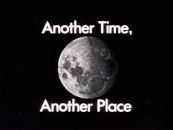
"Another Time, Another Place"
TV episode
Screenplay by Johnny Byrne
Directed by David Tomblin
Original air date: February 6,
1976 |
Passing through a temporal anomaly in
space, the Moon and its popluation is duplicated and the split Alphans experience
very different fates.
Read the episode summary at the Moonbase Alpha wiki
CHARACTERS APPEARING OR MENTIONED IN THIS EPISODE
David Kano
Sandra Benes
Tanya Alexandre
Alan Carter
Paul Morrow
Lee Oswald
Regina Kesslann
Commander Koenig
Dr. Russell
Professor Bergman
Dr. Mathius
Tony Allan
Alan Harris
doppelganger
Regina Kesslann
doppelganger Victor Bergman
doppelganger Sandra Benes
doppelganger Helena Russell
doppelganger Paul Morrow
doppelganger Tanya Alexandre
doppelganger David Kano
doppelganger
Paul and Sandra's son
doppelganger
Paul and Sandra's daughter
DIDJA NOTICE?
At 10:18 on the Blu-ray, the commlock on Dr. Russell's belt
does not have the usual numbers printed on the buttons.
The statistics about Earth's distance from the Sun,
diameter, and rotational period given by Computer are
accurate.
As the Moon enters Earth's solar system,
Paul says that Computer confirms there are nine planets in
the system. But it should be ten planets since the discovery
of the distant planet Meta sometime before
"Breakaway" (at least if we're
counting Pluto, which was still considered a planet in 1999,
at least in our universe; in 2006 Pluto was downgraded to
"dwarf planet", existing with several others in the solar
system). In the Powys novelization of this episode, Paul's
statement has been corrected to ten planets, but in the original Pocket Books version, Paul says it
is eleven planets! That is because in the original TV
episodes, both Meta and Terra Nova ("Matter
of Life and Death") are part of the Earth system and
Terra Nova was encountered before the Moon passed through
the black sun into a very distant part of space in
"Black Sun". In the Powys
timeline, "Matter of
Life and Death" takes place after the journey through
the black hole.
At 13:41 on the Blu-ray, Commander Koenig's communications
screen in his office is labeled as a Pclick 4480. This is a
fictitious brand/model.
At 13:55 on the Blu-ray, Koenig's commlock appears to be the
same "fake" one that was on his person in one scene of
"Earthbound".
After the Moon-split occurs and Regina dies, Dr. Russell examines the body and scans
reveal it had two brains inside the skull. It seems like an
exaggeration to suggest that two brains could exist in one
human skull, but it is also an eerie hint of body horror for
the episode.
At 24:11 on the Blu-ray there are couches in Koenig's office
we've not seen before.
Bergman reports that Earth's axis has changed its tilt by
5-6 degrees.
The Alphans find that an area on Earth called Santa Maria is
likely the only place left on the planet capable of
supporting life. Though there is a real world city called
Santa Maria in the general area of Bergman's map (in
California), it seems he is more generally referring to the
Santa Maria Valley, of which the city is a part. The "future
Alphans" they soon find living there seem to confirm this by
saying there are other habitations "all through the valley."
Bergman's map does not really pinpoint the valley very
accurately though.
When Koenig and Carter enter the abandoned Moonbase Alpha on
the doppelganger Moon, notice that there is no artificial
gravity. They walk as if they are walking on the bare
surface of the Moon.
For some reason, the space helmets on the dead bodies of the
doppelganger Koenig and Carter have their name stickers
under the clear visors instead of above the visors as our
Alphans have. Why should they be different?
The examination performed by Dr. Russell on the bodies of
the doppelganger Koenig and Carter show they died five years
ago, which suggests the doppelganger Moon arrived at Earth
five years before the Moon we follow here.
Bergman remarks that they need at least 24 hours for total
evacuation of the base. But, in "Matter of
Life and Death", it was stated that evacuation would
take 48 hours. Why the difference? I suppose it could be
that after the events of "Matter of
Life and Death", Koenig ordered a review of the
Operation Exodus procedures to make it possible to evacuate
more quickly, such as having a stock of supplies stacked and
ready to be loaded immediately into Eagles, personnel having
their own bug-out kits ready to go, etc.
The doppelganger Bergman explains to Koenig that the planet
they are on is Earth, but not the world they knew. He says
evidence of a past civilization lies everywhere, perhaps of
another Atlantis. His remarks seem to say that this is an
alternate universe.
Atlantis, of course, is a mythological land mass that once
harbored advanced civilization that later suffered a severe
cataclysm and sank beneath the ocean.
What appear to be gravity towers
like those around Moonbase Alpha are seen within the Earth settlement. Presumably they are
used for something other than gravity now.
The doppelganger Sandra and Paul are married. Doppelganger
John and Helena were also married before his death in the
crashed Eagle on the Moon.
At 42:46 on the Blu-ray, a stringed musical instrument is
seen hanging on a wall in the doppelganger Helena's
domicile. It appears to be a mandolin.
When the two Moons re-merge, Carter wonders if their
doppelgangers made it, if they survived. Koenig counters,
"Did they ever really exist?" But, Dr. Russell picks up the
roses she brought back from Bergman's garden on Earth. Since
they still exist, mustn't the duplicate Alphans as well?
 |
Notes from the novelization of
"Another Time, Another Place" by
John Rankine
as it appears in the Space: 1999 Year One
omnibus published by Powys Media.
The page numbers presented here come from the full
Space: 1999 Year One
omnibus. "Another Time, Another Place" begins on page
188 of
the book.
There will also be
notes (as appropriate) from the original adaptation of
"Another Time, Another Place" by
Rankine as it
appeared in Space: 1999 - Moon Odyssey, a merged
novelization of the episodes "Alpha Child", "The Last
Sunset", "Voyager's Return", and
"Another Time, Another Place",
first published by Pocket Books in 1975. (Roughly speaking, chapters
7-8 cover the events of
"Another Time, Another Place"). |
CHARACTERS APPEARING OR MENTIONED IN THIS NOVELIZATION,
NOT IN THE TV EPISODE
Ken Lucas
doppelganger Bill Fraser
doppelganger Annette Fraser
doppelganger Bill and Annette Fraser's daughter
doppelganger Bill and Annette Fraser's son
DIDJA NOTICE?
Professor Bergman has some speculations on the possibility
of maneuvering the Moon in some way to increase their
chances of making planetfall. Did he ever implement these
for later planetfalls?
The novelization reveals that Sandra was in the process of
training Regina as a stand-in for herself as part of a
protocol Commander Koenig had implemented for all senior personnel.
When the Alphans realize the Moon has been thrust back into
Earth's system on page 193, it is referred to as their
Ithaca. This is a reference to the Greek island of Ithaca,
to which the hero Odysseus seeks to return in Homer's
classic tale of the Odyssey.
On page 195, artist Ken Lucas provides some art supplies to
Dr. Mathias for Regina's use while she recovers in the
medical center. Lucas is later mentioned in the novelization
of "End of Eternity" and appears in Resurrection.
On page 197, the crazed Regina is described as "moving
jerkily in her floating flimsy wrap like a Maenad maddened
and stung by an ivy leaf brew." The maenads were the female
followers of Dionysus, Greek god of winemaking, vegetation,
and insanity; they often wore ivy or decorated objects with
it.
On page 199, Bergman, hearing Alpha's own navigation signal
coming at them from the duplicate Moon orbiting Earth,
struggles to remember something that is more than déjà
vu,
less than memory, and which has been nagging at him since
their Moon's emergence from the black sun. At the end of the
novelization of
"Black Sun",
it seemed that the mysterious
unknown force had taken away from Bergman the memory of Meta
being the Moon somehow returned to the outskirts of the Sol
system, as he'd realized at the end of
"Operation Deliverance".
Page 202 depicts our first glimpse of real
physical intimacy between John and Helena. Having just
completed examinations of the bodies of the doppelganger
Koenig and Carter, and knowing what happened to Regina, she
fears for John's life in his intention to go down to the
Santa Maria Valley on Earth, and she warns him to be careful,
placing her head on his chest as they stand together and he
strokes her hair. And on page 203, as they decide that she
must accompany him and Carter to Earth's surface for a Phase
One probe, he slides his hands under the silky bell of fair
hair and touches her forehead with his mouth.
Later, aboard the Eagle, while Carter is in the
command module piloting, John and Helena are alone in the
passenger module and its implied they make love for the
first time.
Page 204 states that the tune the doppelganger Bergman is
whistling while he works on the plants at the settlement is
Beethoven's "Ode to Joy".
After the Moon-merge on page 210, the Alphans in Main
Mission are described as wondering if they were as alone as
a wandering Ka or if what they saw on the big screen was
real. Ka is an ancient Egyptian term for what we
would today probably call a soul.
 |
Notes from the "Journey to the Future"
adaptation of "Another Time,
Another Place"
German comic strip
Zack
#24
Koralle-Verlag GmbH
Text: Farinas
Art: Cardona
November 17, 1977 |
Zack
was a German comic magazine, 17 issues of which featured a
Space:
1999
strip. Many of the strips were original stories, others
adaptations of the televised episodes. All were written by
Farinas and drawn by
Cardona (Spanish artist José Maria
Cardona Blasi).
On the last panel of page 1 of the story, Regina's dialog
balloon is blank!
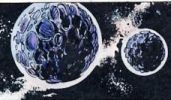
In this comic strip, the Moon not only doubles...it
quintuples! What happened to the Alphans of all those other
Moons aside from the story of the two we actually see here?
On page 4 of the story, Regina sees a double reflection of
herself in the medical center mirror and then she smashes
the mirror in terror. In the televised episode, she sees
just a single image of herself.
In the TV episode, Regina dies, but in this comic strip, she
survives her ordeal. At the end of the story, Koenig even
says she is healthy again.
In the comic strip it is stated plainly that the evidence
suggested Earth had been through a nuclear war that wiped
out civilization some time in the past.
|
On page 11 of the story, the interior of the command module
of the Eagle is larger than seen in the TV episodes and even
has a navigator chair for Koenig! And why would Helena be
sitting in the co-pilot's seat next to Carter?! |
 |
UNANSWERED QUESTIONS
Why did the Eagle piloted by the doppelganger Koenig and
Carter crash "five years ago"? No explanation is given.
MEMORABLE DIALOG
beyond explanation.mp3
Earth orbit confirmed.mp3
not the world we knew.mp3
another Atlantis, perhaps.mp3
did they ever really exist?.mp3
Back to Space: 1999 Episode
Studies
